Glaucous Macaw
Anodorhynchus glaucus
Avilumen editorial team ·

The glaucous macaw is a critically endangered or possibly extinct species of large, blue and grey South American parrot, a member of a large group of neotropical parrots known as macaws. This macaw is closely related to Lear's macaw and the hyacinth macaw. In Guarani, it is called gua'a hovy after its vocalizations.
The glaucous macaw (Anodorhynchus glaucus) is a critically endangered or possibly extinct species of large, blue and grey South American parrot, a member of a large group of neotropical parrots known as macaws. This macaw is closely related to Lear's macaw (A. leari) and the hyacinth macaw (A. hyacinthinus). In Guarani, it is called gua'a hovy after its vocalizations.
Description
The glaucous macaw is 70 cm (28 in) long. It is mostly pale turquoise-blue with a large, greyish head. The term glaucous describes its colouration. It has a long tail and a large bill. It has a yellow, bare eye ring and half moon-shaped lappets bordering the mandible.
Range and decline
This bird was native to north Argentina, south Paraguay, the chaco and llano region of Bolivia near the city of Santa Cruz de la Sierra, northeast Uruguay, and Brazil. It became rare during the 19th century due to trapping and loss of habitat, and only two possible reports of wild birds were received in the 20th century. Expeditions by ornithologists to southwestern Paraguay during the 1990s failed to turn up any evidence of the species. Furthermore, only the oldest residents of the region had knowledge of the macaw, with the species last recorded in the 1870s. The bird's disappearance probably is linked to trapping of live adults for the wild bird trade and the wholesale felling of the yatay palm, Butia yatay, the nuts of which appear to have constituted its main food. Although suitable habitat remains in El Palmar National Park, in the Argentine province of Entre Ríos, as well as southern Brazil, no rumours of the bird's continued existence in the past several decades have proven credible. A search conducted by Joe Cuddy and Tony Pittman in 1992 concluded that the birds were extinct in their former range. Rumours persisted that blue macaws were seen in Argentina and Bolivia with a dealer in Rosario, Argentina, offering live specimens. The late George Smith gave many talks rich in conservation information on macaws, including this species, which he stated was not extinct in the wild, but existed in remote areas of Bolivia where he had encountered trappers who could identify this species. Moreover, he stated that stands of pure palm existed "as far as the eye could see" when he flew over the area which is yet to be investigated.
A 2018 study citing bird extinction patterns, the heavy destruction of its habitat, and the lack of any confirmed sightings since the 1980s recommended uplisting the species to Critically Endangered – Possibly Extinct.
Text adapted from Wikipedia · CC BY-SA 4.0
Where it lives
Distribution

Taxonomy
- Order
- Psittaciformes
- Family
- Psittacidae
- Genus
- Anodorhynchus
- Conservation status
- Critically endangered
Listen to its call
No recording yet
Care guide
Macaw Care Guide: Diet, Housing and Breeding
How to care for a macaw: diet, cage and aviary size, health, breeding, noise and CITES legal requirements. A practical guide for current and future owners.
Read the guide →Illustration gallery
6 illustrations of Anodorhynchus glaucus (Glaucous Macaw) in different styles, true to its real plumage. Shown watermarked; the art pack includes the high-resolution originals, ready to print.
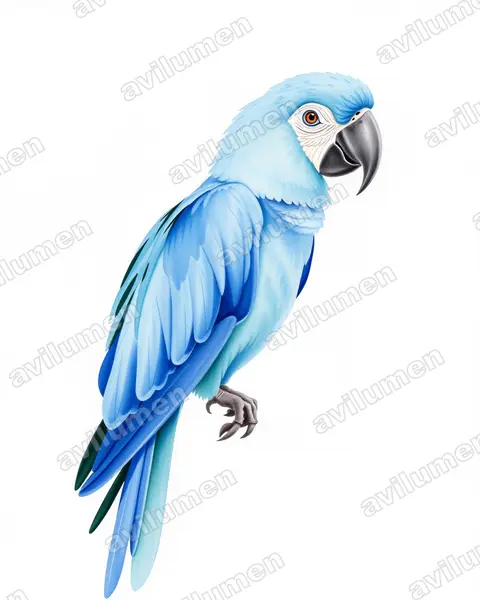
Watercolor 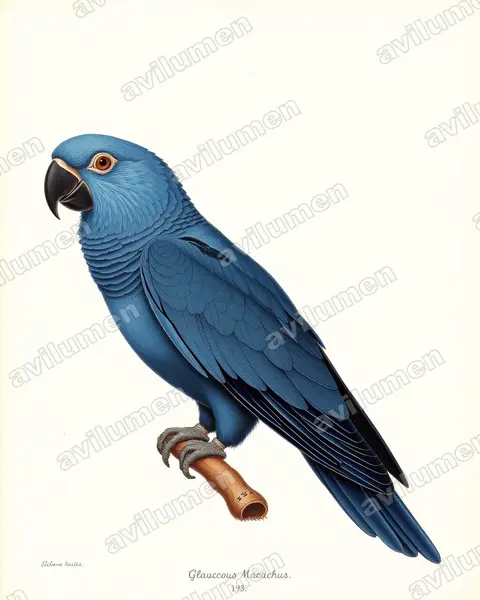
Vintage plate 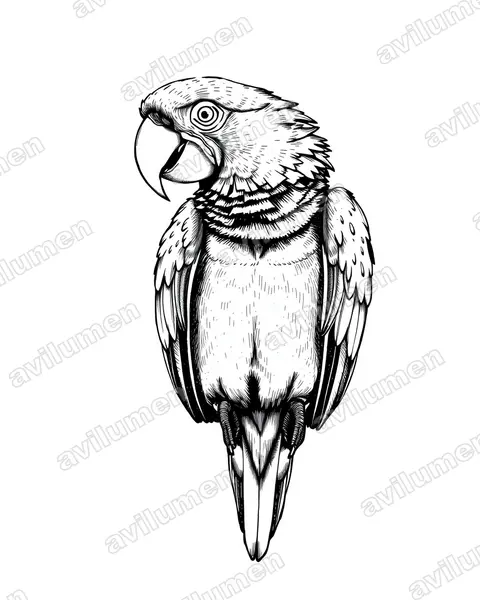
Ink 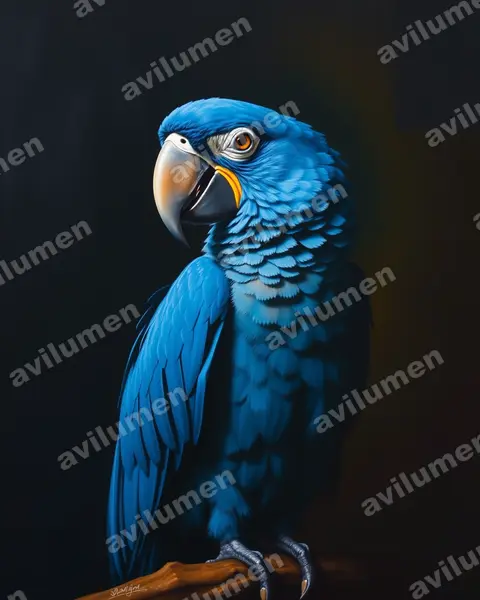
Oil 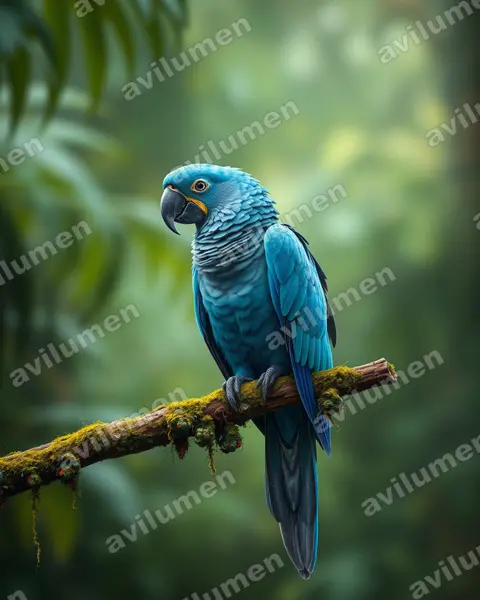
Realistic 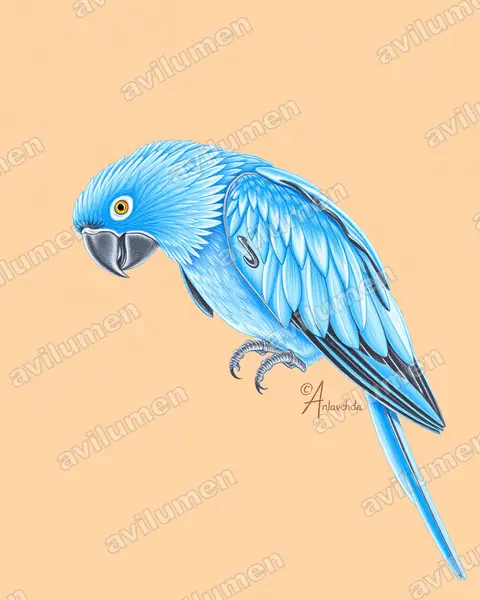
Colored pencil
Digital editions
HD Digital Art Pack — Glaucous Macaw
Digital download: 6 high-resolution illustrations of the Glaucous Macaw (Anodorhynchus glaucus), print-ready. This is a digital file; no animal or physical item is included.
AI Avatar — Glaucous Macaw
Generate an avatar fusing your face with the Glaucous Macaw (Anodorhynchus glaucus). Delivered digitally in 8K, watermark-free. Digital product; no animals are sold or brokered.
Instant download. No live birds are sold.
Frequently asked questions
- Is Anodorhynchus glaucus (Glaucous Macaw) endangered?
- The IUCN Red List places Anodorhynchus glaucus, commonly known as the Glaucous Macaw, in the «Critically endangered» category. «Critically endangered» is the highest threat level before extinction.
- Where does Anodorhynchus glaucus (Glaucous Macaw) live?
- Anodorhynchus glaucus (Glaucous Macaw) is found in Brazil and South America.
- What family does Anodorhynchus glaucus (Glaucous Macaw) belong to?
- Anodorhynchus glaucus (Glaucous Macaw) belongs to the family Psittacidae, in the order Psittaciformes.
- What colour is Anodorhynchus glaucus (Glaucous Macaw)?
- The plumage of Anodorhynchus glaucus (Glaucous Macaw) combines these colours: Blue and Grey.
More from the same family
 Near threatened
Yellow-faced Parrot
Alipiopsitta xanthops
The yellow-faced parrot, formerly also known as the yellow-faced amazon, is the only species of the genus Alipiopsitta. It is a Neotropical parrot, and was classified in the genus Amazona for many years. It is a predominantly green and yellow-plumaged bird with a yellow head. It is a semi-nomadic species found in the cerrado region of Brazil and adjacent Bolivia.
from $1.99
 Least concern
Moluccan King Parrot
Alisterus amboinensis
The Moluccan king parrot is a parrot endemic to Peleng Island, Maluku, and West Papua in Indonesia. It is sometimes referred to as the Ambon king parrot or Amboina king parrot, but this is potentially misleading, as it is found on numerous other islands than Ambon. The male and female are similar in appearance, with a predominantly red head and underparts, green wings, and blue back and tail.
from $1.99
 Least concern
Papuan King Parrot
Alisterus chloropterus
The Papuan king parrot, also known as the green-winged king parrot, is a species of parrot in the family Psittaculidae found in New Guinea. Its natural habitats are subtropical or tropical moist lowland forest and subtropical or tropical moist montane forest.
from $1.99
 Least concern
Australian King Parrot
Alisterus scapularis
The Australian king parrot is a species of parrot endemic to eastern Australia ranging from Cooktown in Queensland to Port Campbell in Victoria. Found in humid and heavily forested upland regions of the eastern portion of the continent, including eucalyptus wooded areas in and directly adjacent to subtropical and temperate rainforest. They feed on fruits and seeds gathered from trees or on the ground.
from $1.99