Budgerigar
Melopsittacus undulatus
Avilumen editorial team ·

The budgerigar, also known as the common parakeet, shell parakeet or budgie, is a small, long-tailed, seed-eating parrot native to Australia. Naturally, the species is green and yellow with black, scalloped markings on the nape, back, and wings. Budgies are bred in captivity with colouring of blues, whites, yellows, greys, and even with small crests.
The budgerigar ( BUJ-ər-ih-gar, -ə-ree-; Melopsittacus undulatus), also known as the common parakeet, shell parakeet or budgie ( BUJ-ee), is a small, long-tailed, seed-eating parrot native to Australia. Naturally, the species is green and yellow with black, scalloped markings on the nape, back, and wings. Budgies are bred in captivity with colouring of blues, whites, yellows, greys, and even with small crests. Juveniles and chicks are monomorphic (the sexes are visually indistinguishable), while adults are told apart by their cere colouring and their behaviour.
The species is monotypic, meaning it is the only member of the genus Melopsittacus, which is the only genus in the tribe Melopsittacini.
The budgerigar is closely related to lories and the fig parrots.
The origin of the budgerigar's name is unclear. First recorded in 1805, budgerigars are popular pets around the world due to their small size, low cost, and ability to mimic human speech. They are the third most popular pet in the world, after the domesticated dog and cat. Budgies are nomadic flock parakeets that have been bred in captivity since the 19th century. In both the wild and in captivity, budgerigars breed opportunistically and in pairs.
They are found wild throughout the drier parts of Australia, where they have survived harsh inland conditions for over five million years. Their success can be attributed to a nomadic lifestyle and their ability to breed while on the move.
Etymology
Several possible origins for the name budgerigar have been proposed. One origin could be that budgerigar may be a mispronunciation or alteration of the Gamilaraay word gidjirrigaa (Aboriginal pronunciation: [ɡ̊iɟiriɡaː]) or gijirragaa from the Yuwaalaraay.
Another possible origin is that budgerigar might be a modified form of budgery or boojery (Australian English slang for "good") and gar ("cockatoo").
While many references mention "good" as part of the meaning, and a few specify "good bird", it is quite possible that reports by those local to the region are more accurate in specifying the direct translation as "good food".
Alternative spellings include budgerygah and betcherrygah, the latter used by Indigenous people of the Liverpool Plains in New South Wales.
Alternative names for the budgerigar include shell parrot or shell parakeet, warbling grass parakeet, canary parrot, zebra parrot, flight bird, and scallop parrot. Although more often used as a common name for small parrots in the genus Agapornis, the name "lovebird" has been used for budgerigars, because of their habit of close perching, mutual preening, and their long term pair-bonds.
The genus name Melopsittacus is coined from Ancient Greek, meaning "melodious parrot". The species name undulatus is Latin for "undulated" or "wave-patterned".
Taxonomy
The budgerigar was first described by George Shaw in 1805, and given its current binomial name by John Gould in 1840. The budgerigar was once proposed to be a link between the genera Neophema and Pezoporus, based on the barred plumage. However, recent phylogenetic studies using DNA sequences place the budgerigar very close to the lories (tribe Loriini) and the fig parrots (tribe Cyclopsittini).
Description
Wild budgerigars average 18 cm (7 in) long, weigh 30–40 grams (1.1–1.4 oz), 30 cm (12 in) in wingspan, and display a light green body colour, while their mantles display pitch-black mantle markings (blackish in fledglings and immatures) edged in clear yellow undulations. The forehead and face is yellow in adults.
Prior to their adult plumage, young individuals have blackish stripes down to the cere in young individuals until around 3–4 months of age. They display small, iridescent blue-violet cheek patches and a series of three black spots across each side of their throat. The two outermost throat spots are situated at the base of each cheek patch. The tail is cobalt, and outside tail feathers display central yellow flashes. Their wings have greenish-black flight feathers and black coverts with yellow fringes along with central yellow flashes, which only become visible in flight or when the wings are outstretched. Bills are olive grey and legs blueish-grey, with zygodactyl toes.
In their natural Australian habitat, budgerigars are noticeably smaller than those in captivity. This particular parrot species has been bred in many other colours and shades in captivity (e.g. blue, grey, grey-green, pieds, violet, white, yellow-blue). Pet store individuals will commonly be blue, green, or yellow. Like most parrot species, budgerigar plumage fluoresces under ultraviolet light – a phenomenon possibly related to courtship and mate selection.
The colour of the cere (the area containing the nostrils) differs between the sexes, being a lavender/baby blue in males, pale brownish/white (non breeding) to brown (breeding) in females, and pink in immature birds of both sexes (usually of a more even purplish-pink colour in young males). Some female budgerigars develop brown cere only during breeding time, which later returns to the normal colour. Young females can often be identified by a subtle, chalky whiteness that starts around the nostrils. Males that are either albino, lutino, dark-eyed clear or recessive pied (Danish pied or harlequin) retain the immature purplish-pink cere colour for their entire lives.
Mature males usually have a cere of light to dark blue, but in some particular colour mutations it can be periwinkle, lavender, purplish or pink – including dark-eyed clears, Danish pieds (recessive pieds) and inos, which usually display much rounder heads. Female budgerigars display more dominant behaviour compared to males of the species and may act aggressively towards them.
Budgerigars have tetrachromatic colour vision, although all four classes of cone cells will not operate simultaneously unless under sunlight or a UV lamp. The ultraviolet spectrum brightens their feathers to attract mates. The throat spots in budgerigars reflect UV and can be used to distinguish individual birds. While ultraviolet light is essential to the good health of caged and pet birds, inadequate darkness or rest results in overstimulation.
Colour mutations
All captive budgerigars are divided into two basic series of colours; namely, white-based (blue, grey and white) and yellow-based (green, grey-green and yellow). Presently, at least 32 primary mutations (including violet) occur, enabling hundreds of possible secondary mutations (stable combined primary mutations) and colour varieties (unstable combined mutations).
Ecology
Budgerigars are nomadic and flocks move on from sites as environmental conditions change. Budgerigars are found in open habitats, primarily in scrublands, open woodlands, and grasslands of Australia. The birds are normally found in small flocks, but can form very large flocks under favourable conditions. The nomadic movement of the flocks is tied to the availability of food and water. Budgerigars have two distinct flight speeds which they are capable of switching between depending on the circumstance. Budgerigars sometimes swarm together in groups containing thousands of individuals.
Drought can drive flocks into more wooded habitat or coastal areas. They feed on the seeds of spinifex and grass, and sometimes ripening wheat. Budgerigars feed primarily on grass seeds. The species also opportunistically depredates growing cereal crops and lawn grass seeds. Due to the low water content of the seeds they rely on the availability of fresh water.
Outside of Australia, a population of naturalised feral budgerigars was present near St. Petersburg, Florida for over 50 years. Increased competition for nesting sites from European starlings and house sparrows is thought to be a primary cause of the Florida population declining from the 1980s, and this population died out in 2014.
Breeding
Breeding in the wild generally takes place between June and September in northern Australia and between August and January in the south, although budgerigars are opportunistic breeders and respond to rains when grass seeds become most abundant. Budgerigars are monogamous and breed in large colonies throughout their range. They show signs of affection to their flockmates by preening or feeding one another. Budgerigars feed one another by eating the seeds themselves, and then regurgitating it into their flockmate's mouth. Populations in some areas have increased as a result of increased water availability at farms. Nests are made in holes in trees, fence posts or logs lying on the ground; the four to six eggs are incubated for 18–21 days, with the young fledging about 30 days after hatching. In the wild, virtually all parrot species require a hollow tree or a hollow log as a nest site. Budgerigars will typically breed in captivity when provided with a nest box.
The eggs are typically one to two centimetres long and are pearl white without any colouration if fertile. Female budgerigars can lay eggs without a male partner, but these unfertilised eggs will not hatch. Females normally have a whitish tan cere; however, when the female is laying eggs, her cere turns a crusty brown colour. Certain female budgies may always keep a whitish tan cere or always keep a crusty brown cere regardless of breeding condition. A female budgerigar will lay her eggs on alternating days. After the first one, there is usually a two-day gap until the next. She will usually lay between four and eight eggs, which she will incubate (usually starting after laying her second or third) for about 21 days each. Females only leave their nests for very quick defecations, stretches and quick meals once they have begun incubating and are by then almost exclusively fed by their mate (usually at the nest's entrance). Females will not allow a male to enter the nest, unless he forces his way inside. Clutch size ranges from 6 to 8 chicks.
There is evidence of same-sex sexual behaviour amongst male budgerigars. It was originally hypothesised that they did this as a form of "courtship practice" so they were better breeding partners for females; however, an inverse relationship exists between participation in same-sex behaviour and pairing success.
Chick health
Breeding difficulties arise for various reasons. Some chicks may die from diseases and attacks from adults. Other budgerigars (virtually always females) may fight over the nest box, attacking each other or a brood. Another problem may be the birds' beaks being under-lapped, where the lower mandible is above the upper mandible.
Most health issues and physical abnormalities in budgerigars are genetic. Care should be taken that birds used for breeding are active, healthy and unrelated. Budgerigars that are related or have fatty tumours or other potential genetic health problems should not be allowed to breed. Parasites (lice, mites, worms) and pathogens (bacteria, fungi and viruses), are contagious and thus transmitted between individuals through either direct or indirect contact.
In some cases, chicks will experience splay leg. This medical condition may be congenital or acquired through malnutrition. Chicks can be treated with splints although this method is not always successful in curing the affected bird. Preventative measures include using proper nesting box materials such as pine shavings and cleaning the nest box between uses.
Development
Eggs take about 18–20 days before they start hatching. The hatchlings are altricial – blind, naked, unable to lift their head and totally helpless, and their mother feeds them and keeps them warm constantly. Around 10 days of age, the chicks' eyes will open, and they will start to develop feather down. The appearance of down occurs at the age for closed banding of the chicks.
They develop feathers around three weeks of age. (One can often easily note the colour mutation of the individual birds at this point.) At this stage of the chicks' development, the male usually has begun to enter the nest to help his female in caring for and feeding the chicks. Some budgerigar females, however, totally forbid the male from entering the nest and thus take the full responsibility of rearing the chicks until they fledge.
Depending on the size of the clutch and most particularly in the case of single mothers, it may then be wise to transfer a portion of the hatchlings (or best of the fertile eggs) to another pair. The foster pair must already be in breeding mode and thus either at the laying or incubating stages, or already rearing hatchlings.
As the chicks develop and grow feathers, they are able to be left on their own for longer periods of time. By the fifth week, the chicks are strong enough that both parents will be comfortable in staying out of the nest more. The youngsters will stretch their wings to gain strength before they attempt to fly. They will also help defend the box from enemies, mostly with their loud screeching. Young budgerigars typically fledge (leave the nest) around their fifth week of age and are usually completely weaned between six and eight weeks old. However, the age for fledging, as well as weaning, can vary slightly depending on the age and the number of surviving chicks. Generally speaking, the oldest chick is the first to be weaned. Although it is logically the last one to be weaned, the youngest chick is often weaned at a younger age than its older sibling(s). This can be a result of mimicking the actions of older siblings. Lone surviving chicks are often weaned at the youngest possible age as a result of having their parents' full attention and care.
Hand-reared budgies may take slightly longer to wean than parent-raised chicks. Hand feeding is not routinely done with budgerigars, due to their small size and because young parent raised birds can be readily tamed.
Text adapted from Wikipedia · CC BY-SA 4.0
Distribution

Taxonomy
- Order
- Psittaciformes
- Family
- Psittacidae
- Genus
- Melopsittacus
- Conservation status
- Least concern
Listen to its call
No recording yet
Budgerigar on video
Metraje: Envato Elements (licencia comercial)
Care guide
Budgie, Conure and Parakeet Care Guide
How to care for budgies, conures, parrotlets, ringnecks and other parakeets: diet, cage setup, health, behavior, breeding and legal status for owners.
Read the guide →Illustration gallery
6 illustrations of Melopsittacus undulatus (Budgerigar) in different styles, true to its real plumage. Shown watermarked; the art pack includes the high-resolution originals, ready to print.
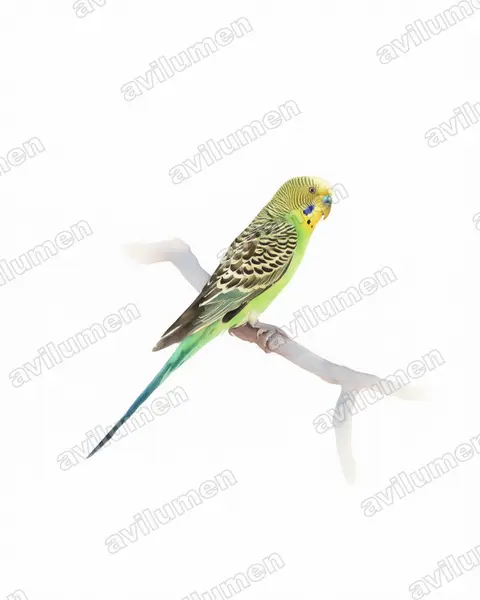
Watercolor 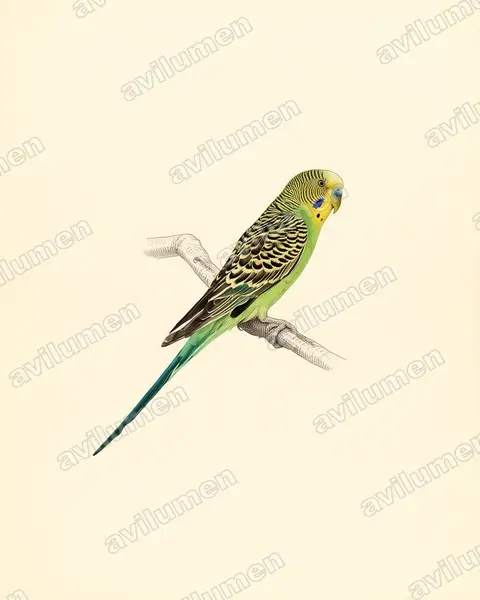
Vintage plate 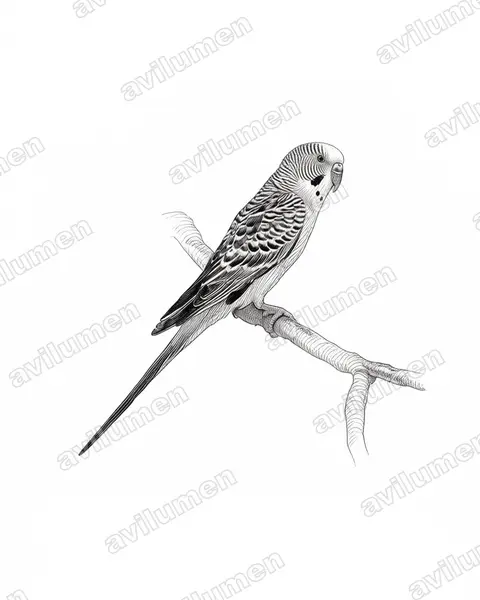
Ink 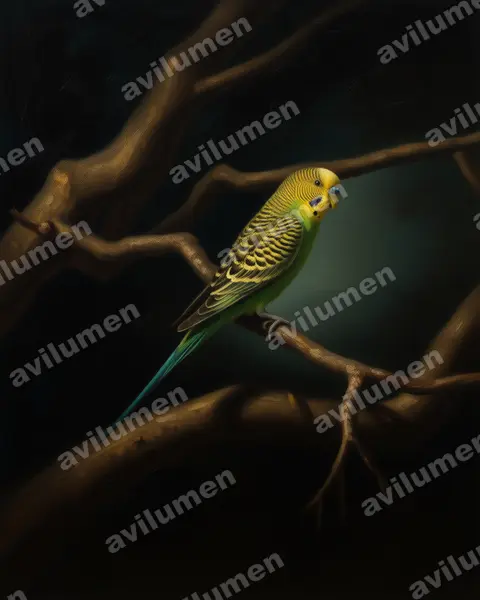
Oil 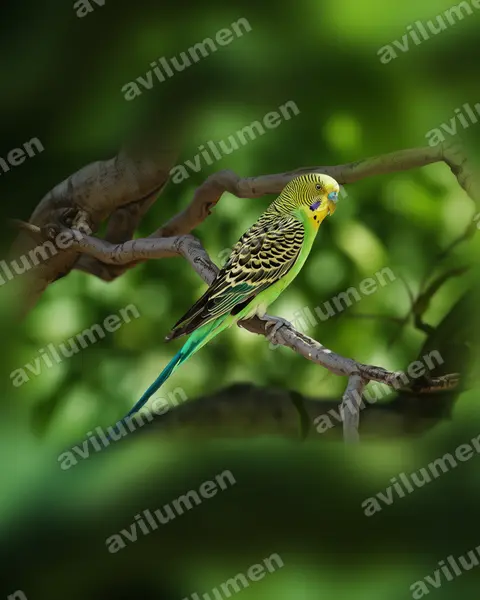
Realistic 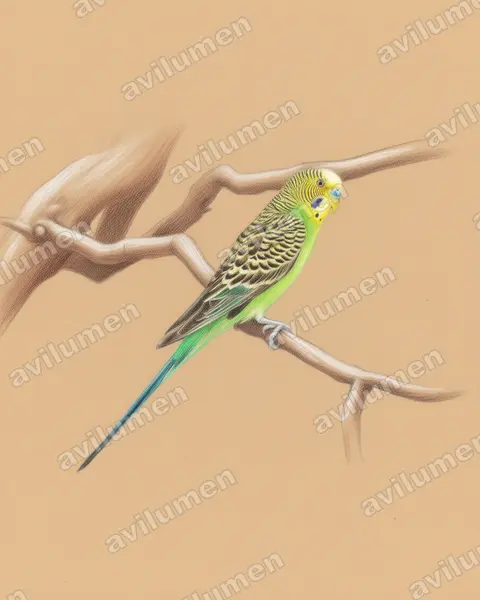
Colored pencil
Illustrations based on the photograph by Benjamint444 (GFDL 1.2), from Wikimedia Commons.
Digital editions
HD Digital Art Pack — Budgerigar
Digital download: 6 high-resolution illustrations of the Budgerigar (Melopsittacus undulatus), print-ready. This is a digital file; no animal or physical item is included.
AI Avatar — Budgerigar
Generate an avatar fusing your face with the Budgerigar (Melopsittacus undulatus). Delivered digitally in 8K, watermark-free. Digital product; no animals are sold or brokered.
Instant download. No live birds are sold.
Frequently asked questions
- Is Melopsittacus undulatus (Budgerigar) endangered?
- The IUCN Red List places Melopsittacus undulatus, commonly known as the Budgerigar, in the «Least concern» category. «Least concern» means it is not currently threatened.
- Where does Melopsittacus undulatus (Budgerigar) live?
- Melopsittacus undulatus (Budgerigar) is found in Africa and Australia.
- What family does Melopsittacus undulatus (Budgerigar) belong to?
- Melopsittacus undulatus (Budgerigar) belongs to the family Psittacidae, in the order Psittaciformes.
- What colour is Melopsittacus undulatus (Budgerigar)?
- The plumage of Melopsittacus undulatus (Budgerigar) combines these colours: Green and Yellow.
More from the same family
 Near threatened
Yellow-faced Parrot
Alipiopsitta xanthops
The yellow-faced parrot, formerly also known as the yellow-faced amazon, is the only species of the genus Alipiopsitta. It is a Neotropical parrot, and was classified in the genus Amazona for many years. It is a predominantly green and yellow-plumaged bird with a yellow head. It is a semi-nomadic species found in the cerrado region of Brazil and adjacent Bolivia.
from $1.99
 Least concern
Moluccan King Parrot
Alisterus amboinensis
The Moluccan king parrot is a parrot endemic to Peleng Island, Maluku, and West Papua in Indonesia. It is sometimes referred to as the Ambon king parrot or Amboina king parrot, but this is potentially misleading, as it is found on numerous other islands than Ambon. The male and female are similar in appearance, with a predominantly red head and underparts, green wings, and blue back and tail.
from $1.99
 Least concern
Papuan King Parrot
Alisterus chloropterus
The Papuan king parrot, also known as the green-winged king parrot, is a species of parrot in the family Psittaculidae found in New Guinea. Its natural habitats are subtropical or tropical moist lowland forest and subtropical or tropical moist montane forest.
from $1.99
 Least concern
Australian King Parrot
Alisterus scapularis
The Australian king parrot is a species of parrot endemic to eastern Australia ranging from Cooktown in Queensland to Port Campbell in Victoria. Found in humid and heavily forested upland regions of the eastern portion of the continent, including eucalyptus wooded areas in and directly adjacent to subtropical and temperate rainforest. They feed on fruits and seeds gathered from trees or on the ground.
from $1.99