Western rosella
Platycercus icterotis
Avilumen editorial team ·

The western rosella, or moyadong, is a species of parrot endemic to southwestern Australia. The head and underparts are bright red, and the back is mottled black; a yellow patch at the cheek distinguishes it from others of the genus Platycercus.
The western rosella (Platycercus icterotis), or moyadong, is a species of parrot endemic to southwestern Australia. The head and underparts are bright red, and the back is mottled black; a yellow patch at the cheek distinguishes it from others of the genus Platycercus. Adults of the species exhibit sexual dimorphism with the females duller overall; juveniles lack the striking colours of mature birds and the characteristic patterning is not as easily distinguished. Their communication call is a softly delivered pink-pink sound, and much of their behaviour is comparatively unobtrusive. Their habitat is in eucalypt forests and woodlands, where they often remain unobserved until they appear to feed on seeds at nearby cleared areas.
Individuals form mating pairs and generally remain in one locality, although they will venture out to join small groups at plentiful sources of food. The western rosella is predominantly herbivorous, its diet consisting mostly of seeds of grasses and other plants, although nectar and insect larvae are sometimes eaten. The damage attributed to the species at introduced fruit and grain crops saw them declared as a pest and permitted by the state to be killed or captured. They are more placid and sociable than rosellas of other Australian regions from which they are geographically isolated and have become internationally popular as an aviary bird. Their history in aviculture begins with two 1830 lithographs of live specimens in England by Edward Lear. Successful breeding in captivity began there during the early 20th century.
The population is classified as two subspecies, representing an inland group residing in the agricultural district and another nearer the coast in kwongan, tall forest and a variety of woodlands. The abrupt intersection of these groups' range, delineated by country of lower rainfall between Albany and Geraldton, is a zone of hybridisation between the two subspecies Platycercus icterotis icterotis and P. icterotis xanthogenys. The classification of the species relationship to sister taxa of Platycercus is less complex, due to their ecological and geographic isolation, and they are allied to a subgenus Platycercus (Violania) .
Taxonomy
The first description of the species was published by C. J. Temminck and Heinrich Kuhl in 1820 as Psittacus icterotis, using a collection obtained at King George Sound (Albany, Western Australia). Kuhl was once mistakenly given sole authorship for the description; this was later corrected to include Temminck; Kuhl himself cited Temminck's earlier work in the text describing their three specimens. The epithet icterotis, meaning 'yellow ear', is derived from ancient Greek and presumed to refer to the yellow cheek. They were separated from the genus Psittacus in 1830 by Nicholas Vigors, to the genus Platycercus he had erected five years earlier; the specific epithet he nominated was Platycercus stanleyii.
Two subspecies are recognised at the Australian Faunal Directory, the nominate Platycercus icterotis icterotis and a description of inland specimens as subspecies Platycercus icterotis xanthogenys. The inland subspecies cites Tommaso Salvadori's 1891 description of a new species Platycercus xanthogenys, published in the Proceedings of the Zoological Society, emerging from his work on a catalogue of psittacine specimens at the British Museum; the latter work contains an illustration of the holotype by J. G. Keulemans.
A revision in 1955 by Arthur Cain proposed the type locality for P. icterotis xanthogenys was Wongan Hills, arbitrarily, but accepted as logical in assuming that John Gould's field worker, John Gilbert, could have obtained a specimen there and it resembled those found occurring at that location. A revision by Herbert Condon, published in the Checklist of the Birds of Australia (RAOU, 1975), supports a classification of two subspecies:
Platycercus (Violania) icterotis icterotis (Temminck & Kuhl, 1820)
synonyms: Psittacus icterotis Temminck & Kuhl, 1820 [and Temminck 1821]; Platycercus stanleyii Vigors, 1830; Platycercus icterotis salvadori Mathews.
Platycercus (Violania) icterotis xanthogenys Salvadori, 1891
synonyms: Platycercus xanthogenys Salvadori, 1891; Platycercus icterotis whitlocki Mathews, 1912.
Revision and cataloguing in the 20th century began to examine the classification of the few known specimens, often supplied without location details, and, excepting A. J. North, cited the work of Savadori in 1891. In a review of material in the Tring collection in England, supplemented by Bernard Woodward at the Perth Museum and the collection of field worker J. T. Tunney, the trinomial Platycercus icterotis xanthogenys was published by Ernst Hartert in 1905. The author Gregory Mathews, an avid exponent of subspecific classification, cites the species Platycercus xanthogenys Salvadori, but disposed of the epithet xanthogenys when tentatively proposing three new taxa. Mathews notes Salvadori's separation of the type specimen from two others in the Gould collection, then held at the London museum, and caution in only giving the source of the skin as "unknown, but probably Australia". Mathews proposed three subspecies in 1912, each given a brief distinguishing remark to be expanded in a later volume of his series Birds of Australia.
The entry in that 1917 work addresses the type of nominate P. icterotis icterotis, which he had earlier ascribed to the location "Shark Bay". This was corrected by Mathews to the location "Albany, South-West Australia". In the preface to the same volume, Mathews attributes the material examined from the southwest of Australia to the collections of the botanist Robert Brown on the Flinders expedition.
The author also corrected his reference to "Point Cloates", given in his 1912 determination of the unknown source of the type in Salvadori's 1891 description, Platycercus xanthogenys. He put the location beyond York, Western Australia. This is where John Gilbert was known to have collected when visiting the western colony in the 1830s.
A new taxon P. icterotis salvadori (yellow-cheeked parrot) differentiates those found at Wilson's Inlet as "having less red on the mantle", and another, P. icterotis whitlocki (Dundas yellow-cheeked parrot), as smaller, less blue at the wing, and more subdued red feathers at the head in the specimens obtained from Lake Dundas (Dundas). The epithet whitlocki was used by authors in ornithological literature to honour the Western Australian field research of Frederick Lawson Whitlock. The notes of Whitlock and other authors reporting from Western Australia, including Tom Carter and A. W. Milligan, were assembled or quoted by Mathews. Errors introduced to the scant body of knowledge by himself and others were acknowledged. The variation in the colours of the back was proposed to accord with differing habitat or as a characteristic of fully mature plumage. He concluded there were at least two subspecies—approximating the coastal and inland forms—that may prove to be more diverse if a complete series of specimens was examined.
The description of the population as two or three subspecific taxa by Mathews is cited within the species circumscription, his P. icterus whitlocki, along with Salvadori's P. xanthogenys, are noted as synonyms for the inland subspecies.
The platycercine parrots have seen various systematic arrangements to circumscribe the contentious sister taxa of northern and eastern Australia, most of which overlap in range and intergrade. One study resulted in new genera being published by Wells and Wellington in 1992. In their classification, the genus name Hesperapsittacus was described, and this species was proposed as the type. That revision was subsumed several years later, by Richard Schodde (1997), to subgeneric names; the name Hesperapsittacus became available for Schodde's subgenus, but he nominated their genus name Violania instead for the alliance of subgenus Platycercus (Violania) Wells & Wellington, 1992. Consequently, the two genera of Wells and Wellington, Violania and Hesperapsittacus, became synonymous with the subgeneric name of this species. This arrangement allies the western species to the "Platycercus eximius-adscitus-venustus" complex, which were separated to species by Les Christidis and Boles in 2008. The validity of the alliances in the subgeneric arrangement, especially of Platycercus (Violania), was tested in 2015, with a multilocus approach to phylogenetic analysis, and proposed a hypothesis that challenges the relationships within the genus.
Common names for moyadong include western rosella, rosehill, rosella and roselle, vernacular that appears to have elided from an early name for a species observed at Rose Hill, New South Wales, "Rose-Hiller", and translocated with its origin forgotten. The names Stanley rosella and yellow-cheeked rosella or parakeet are historical and trade alternatives. The name Western rosella was formally assigned by the Royal Australasian Ornithologists Union (RAOU) (now BirdLife Australia) in 1923 to distinguish the name rosella or 'rose-hiller'. These were retroactively assigned as geographic descriptors of the name 'rosella', an informal name that persisted from the colonial period into the 20th century. Gould also records 'rose-hill' as an informal ('colonial') name for this species and two others existing in the local language. An 1898 report of the Australasian Association for the Advancement of Science listing vernacular for Australian birds proposed "Yellow-cheeked Parrakeet" for this species.
Another early name was The Earl of Derby's Parrakeet, an appellation applied by Gould in 1848 to conserve the honour given to a titled Englishman Edward Smith-Stanley in the epithet used by Vigors, stanleyii, that was displaced by the rule of precedence with the earlier epithet, icterotis, assigned by Kuhl. Gould's explanation of his neologism in naming the 'parrakeet' was inserted with the apology "as bound by justice to the first describer … I feel I shall have the acquiescence of all ornithologists". The caption to the 1830 lithographs in Lear's Illustrations of the Family of Psittacidae, or Parrots also gives "Stanley Parrakeet" for his patron, then known as Lord Stanley, applying the name "Platycercus stanleyii" published by Vigors in the same year. Other terms are used to identify two specimens illustrated in Mathews Birds of Australia (v.6, 1917), distinguished by the descriptors 'red-mantled' and 'yellow-cheeked' parrots. The bird was marketed by dealers in England as a 'small variety' of the commonly kept rosella, P. eximius, and maintained the Earl's appellation. Popular names for the species in aviculture include Stanley rosella for the species, and the western rosella for the nominate form, and 'red-backed western' or 'Salvadori' rosella for the inland subspecies, P. icterosis xanthogenys, when recognised as distinct; the latter is noted and named for dark red feathers at the back. "Western Rosella" has been designated as the official name of the species by the International Ornithological Committee (IOC), the same name assigned by the RAOU in 1923.
The pre-existing names, derived from the Nyungar language, were recorded as regional and literal variants, representing dialectic shifts and often inconsistent spelling by the transcriber. These were first compiled by the colonial diarist George Fletcher Moore, supplementing the work of others with his own, and first published in 1842. The names of Moore and other authors were reviewed and published in Serventy and Whittell Birds of Western Australia (1948, & eds.), those recorded at "Perth", Good-un-goodt-un, Guddanang-uddan and Guldanguldan, and at "Avon River", Moy-a-duk and Moyadong, the second location referring to the district at Avon River. A recommended orthography and pronunciation list (Abbott, 2009) of Nyungar avian nomenclature, with broad cultural consultation, has proposed moyadong [moy’a’dawng] and kootonkooton [koot’awn’koot’awn] be adopted to complement the systematic nomenclature.
Text adapted from Wikipedia · CC BY-SA 4.0
Taxonomy
- Order
- Psittaciformes
- Family
- Psittacidae
- Genus
- Platycercus
- Conservation status
- Least concern
Listen to its call
No recording yet
Care guide
Budgie, Conure and Parakeet Care Guide
How to care for budgies, conures, parrotlets, ringnecks and other parakeets: diet, cage setup, health, behavior, breeding and legal status for owners.
Read the guide →Illustration gallery
6 illustrations of Platycercus icterotis (Western rosella) in different styles, true to its real plumage. Shown watermarked; the art pack includes the high-resolution originals, ready to print.
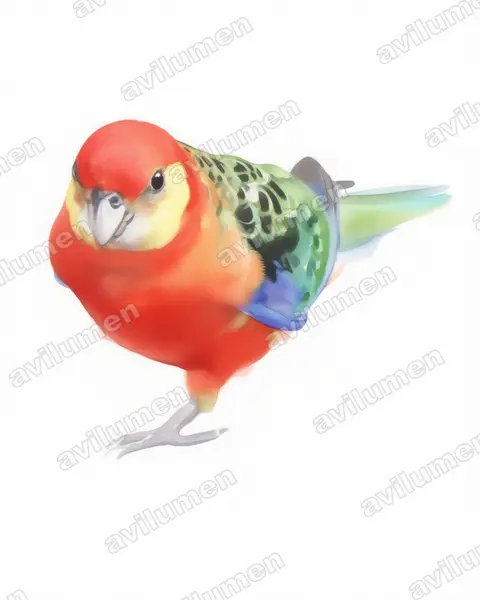
Watercolor 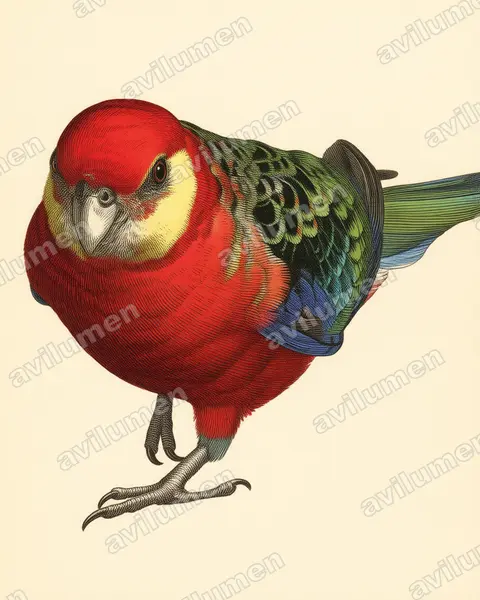
Vintage plate 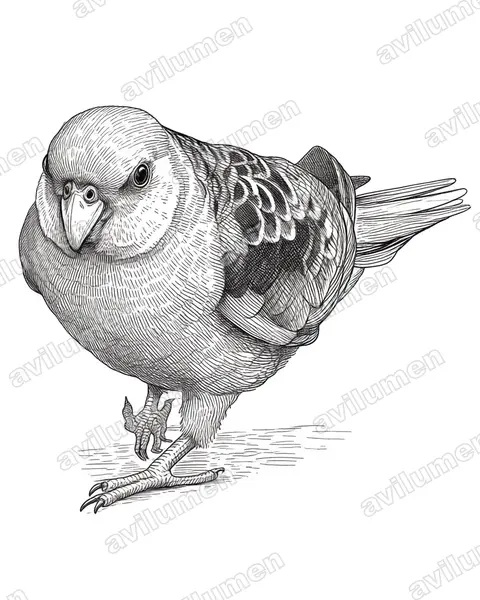
Ink 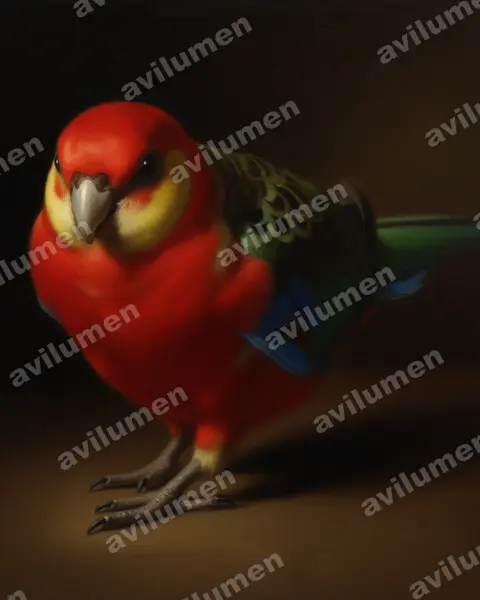
Oil 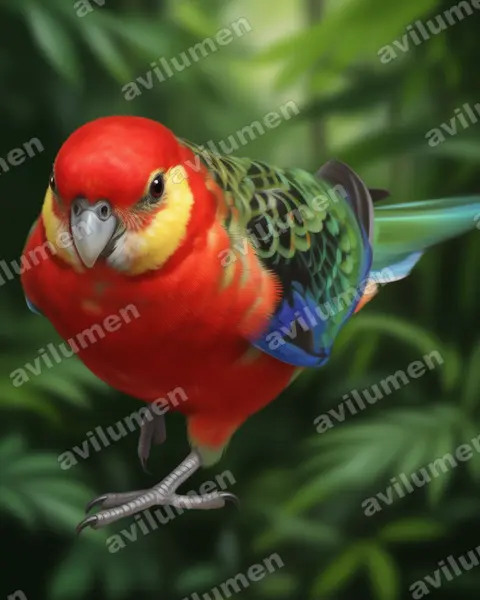
Realistic 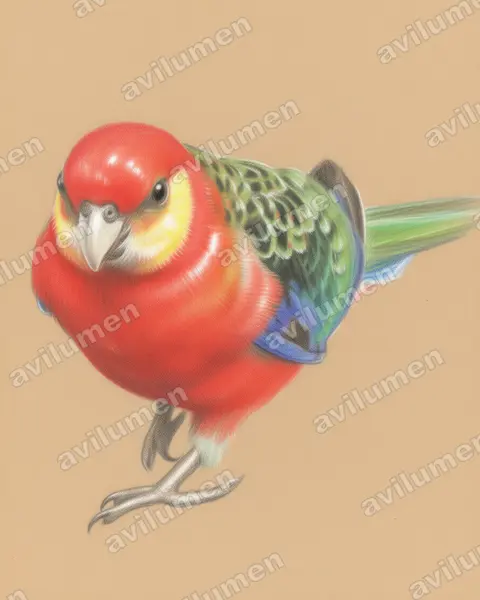
Colored pencil
Illustrations based on the photograph by https://www.flickr.com/photos/httpwwwflickrcomphotostopend/ (CC BY 2.0), from Wikimedia Commons.
Digital editions
HD Digital Art Pack — Western rosella
Digital download: 6 high-resolution illustrations of the Western rosella (Platycercus icterotis), print-ready. This is a digital file; no animal or physical item is included.
AI Avatar — Western rosella
Generate an avatar fusing your face with the Western rosella (Platycercus icterotis). Delivered digitally in 8K, watermark-free. Digital product; no animals are sold or brokered.
Instant download. No live birds are sold.
Frequently asked questions
- Is Platycercus icterotis (Western rosella) endangered?
- The IUCN Red List places Platycercus icterotis, commonly known as the Western rosella, in the «Least concern» category. «Least concern» means it is not currently threatened.
- What family does Platycercus icterotis (Western rosella) belong to?
- Platycercus icterotis (Western rosella) belongs to the family Psittacidae, in the order Psittaciformes.
- What colour is Platycercus icterotis (Western rosella)?
- The plumage of Platycercus icterotis (Western rosella) combines these colours: Red, Black, and Yellow.
More from the same family
 Near threatened
Yellow-faced Parrot
Alipiopsitta xanthops
The yellow-faced parrot, formerly also known as the yellow-faced amazon, is the only species of the genus Alipiopsitta. It is a Neotropical parrot, and was classified in the genus Amazona for many years. It is a predominantly green and yellow-plumaged bird with a yellow head. It is a semi-nomadic species found in the cerrado region of Brazil and adjacent Bolivia.
from $1.99
 Least concern
Moluccan King Parrot
Alisterus amboinensis
The Moluccan king parrot is a parrot endemic to Peleng Island, Maluku, and West Papua in Indonesia. It is sometimes referred to as the Ambon king parrot or Amboina king parrot, but this is potentially misleading, as it is found on numerous other islands than Ambon. The male and female are similar in appearance, with a predominantly red head and underparts, green wings, and blue back and tail.
from $1.99
 Least concern
Papuan King Parrot
Alisterus chloropterus
The Papuan king parrot, also known as the green-winged king parrot, is a species of parrot in the family Psittaculidae found in New Guinea. Its natural habitats are subtropical or tropical moist lowland forest and subtropical or tropical moist montane forest.
from $1.99
 Least concern
Australian King Parrot
Alisterus scapularis
The Australian king parrot is a species of parrot endemic to eastern Australia ranging from Cooktown in Queensland to Port Campbell in Victoria. Found in humid and heavily forested upland regions of the eastern portion of the continent, including eucalyptus wooded areas in and directly adjacent to subtropical and temperate rainforest. They feed on fruits and seeds gathered from trees or on the ground.
from $1.99