Meyer's Parrot
Poicephalus meyeri
Avilumen editorial team ·

Meyer's parrot, also known as the brown parrot, is a species of parrot native to Africa. A Meyer's parrot has black feathers, turquoise belly, blue rump, and bright yellow markings on the carpal joint of the wings. Most subspecies have some yellow on the top of the head as well. Forshaw (1989) recognizes six subspecies of P.
Meyer's parrot (Poicephalus meyeri), also known as the brown parrot, is a species of parrot native to Africa. A Meyer's parrot has black feathers, turquoise belly, blue rump, and bright yellow markings on the carpal joint of the wings. Most subspecies have some yellow on the top of the head as well. Forshaw (1989) recognizes six subspecies of P. meyeri which vary in home range, size and in markings, including the extent of yellow markings to the head and wings, and the intensity of turquoise markings on the belly and rump.
Taxonomy
German physician and ornithologist Philipp Jakob Cretzschmar described Meyer's parrot in 1827. The name commemorates the German ornithologist Bernhard Meyer.
The six subspecies are:
P. m. meyeri (Cretzschmar, 1827) — s Chad to w Ethiopia
P. m. saturatus (Sharpe, 1901) — Uganda and w Kenya to w Tanzania
P. m. matschiei (Neumann, 1898) — c Tanzania, se Congo, Zambia and n Malawi
P. m. reichenowi (Neumann, 1898) — c Angola to s Congo
P. m. damarensis (Neumann, 1898) — n Namibia, s Angola and nw Botswana
P. m. transvaalensis (Neumann, 1899) — Botswana, Zimbabwe and n South Africa
Subspecies P. m. damarensis and P. m. reichenowi lack yellow markings on the head, while P. m. transvaalensis may have little to no yellow on the head. Belly and rump colours vary according to subspecies from turquoise to blue.
Distribution and habitat
Meyer's parrots are native to the plateau woodlands of sub-Saharan Africa where they occur in several woodland types including miombo, savanna woodlands, wooded grasslands and forests bordering watercourses or agricultural land. They are found in high densities in the Okavango Delta region of Botswana. They are also found in southern and central Africa (Chad, Sudan, South Sudan, Ethiopia, Congo, Angola, Tanzania, Zambia, Zimbabwe, Mozambique, and Namibia.
Food and feeding
Their wild diet includes fruit, seeds, nuts, berries and cultivated crops. Seeds of the various leguminous trees of the African woodlands are especially favoured, providing their staple food in some areas. Although they normally travel in pairs or small flocks, wild Meyer's parrots may gather in much larger numbers where food is plentiful. In drought years they wander in search of food.
Breeding
The Meyer's parrot nests in tree cavities. The eggs are white and there are usually three or four in a clutch. The female incubates the eggs for about 28 days and the chicks leave the nest about 60 days after hatching.
Conservation status
Meyer's parrots are still common in the wild, although numbers have decreased locally following destruction of woodlands. It is generally not considered to be at risk, as their large population, limited pressure from trade and hunting, and 6,000,000 km2 home range make these birds unlikely to face extinction in the near future. Trade in Meyer's parrots that have been bred in aviculture is legal. Meyer's parrots are listed on Appendix II of the Convention on International Trade in Endangered Species of Wild Flora and Fauna. Appendix II listing means the species can also be taken from the wild and traded in 'limited' numbers.
In aviculture
Meyer's parrots are commonly bred for the pet trade. They are relatively quiet and small and are able to learn dozens of words.
Text adapted from Wikipedia · CC BY-SA 4.0
Distribution

Taxonomy
- Order
- Psittaciformes
- Family
- Psittacidae
- Genus
- Poicephalus
- Conservation status
- Least concern
Listen to its call
No recording yet
Care guide
Amazon, African Grey and Eclectus Parrot Care Guide
How to care for Amazon parrots, African greys, eclectus and pionus: diet, cage setup, health, behavior and CITES requirements for medium and large parrots.
Read the guide →Illustration gallery
6 illustrations of Poicephalus meyeri (Meyer's Parrot) in different styles, true to its real plumage. Shown watermarked; the art pack includes the high-resolution originals, ready to print.
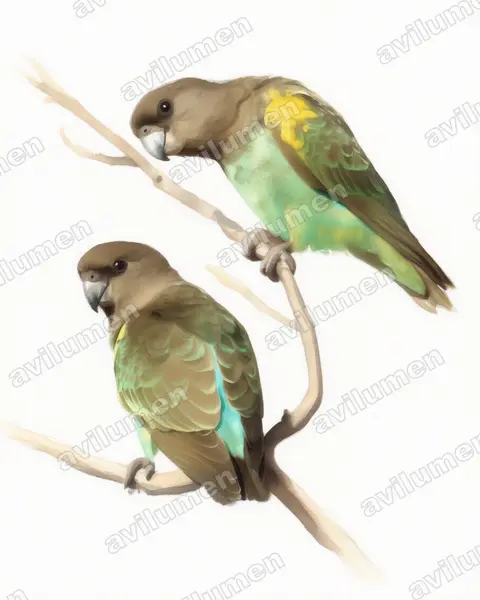
Watercolor 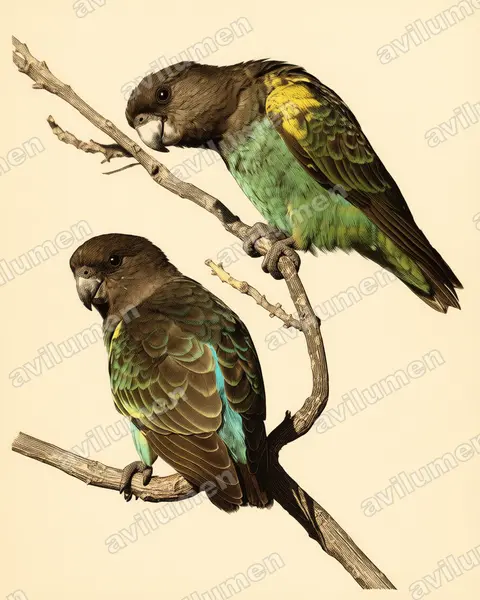
Vintage plate 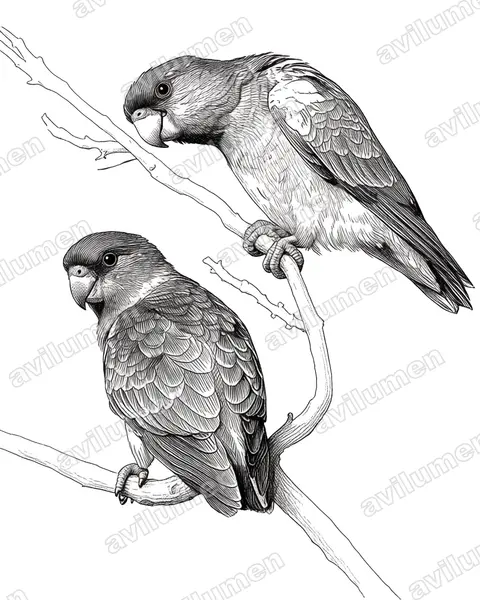
Ink 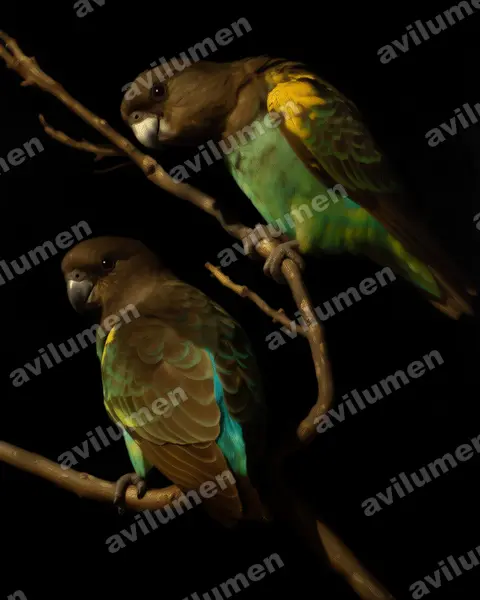
Oil 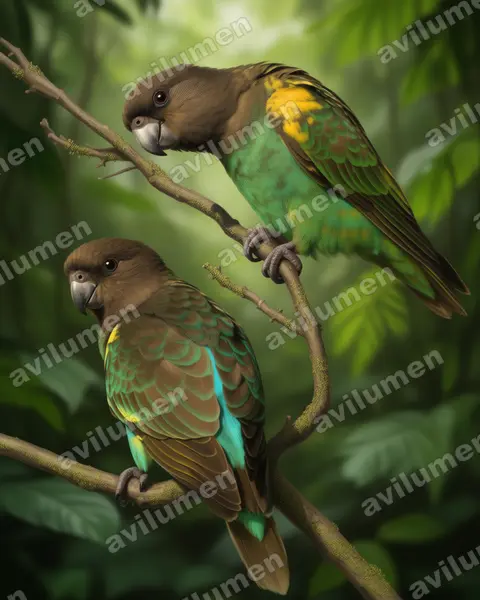
Realistic 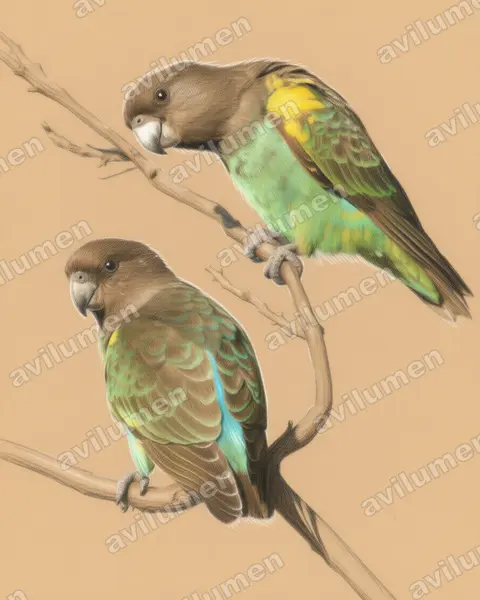
Colored pencil
Illustrations based on the photograph by Poicephalus_meyeri_-Zimbabwe_-two-8.jpg: Oce Eeco derivative work: Snowmanradio (CC BY 2.0), from Wikimedia Commons.
Digital editions
HD Digital Art Pack — Meyer's Parrot
Digital download: 6 high-resolution illustrations of the Meyer's Parrot (Poicephalus meyeri), print-ready. This is a digital file; no animal or physical item is included.
AI Avatar — Meyer's Parrot
Generate an avatar fusing your face with the Meyer's Parrot (Poicephalus meyeri). Delivered digitally in 8K, watermark-free. Digital product; no animals are sold or brokered.
Instant download. No live birds are sold.
Frequently asked questions
- Is Poicephalus meyeri (Meyer's Parrot) endangered?
- The IUCN Red List places Poicephalus meyeri, commonly known as the Meyer's Parrot, in the «Least concern» category. «Least concern» means it is not currently threatened.
- Where does Poicephalus meyeri (Meyer's Parrot) live?
- Poicephalus meyeri (Meyer's Parrot) is found in Africa.
- What family does Poicephalus meyeri (Meyer's Parrot) belong to?
- Poicephalus meyeri (Meyer's Parrot) belongs to the family Psittacidae, in the order Psittaciformes.
- What colour is Poicephalus meyeri (Meyer's Parrot)?
- The plumage of Poicephalus meyeri (Meyer's Parrot) combines these colours: Black, Yellow, and Blue.
More from the same family
 Near threatened
Yellow-faced Parrot
Alipiopsitta xanthops
The yellow-faced parrot, formerly also known as the yellow-faced amazon, is the only species of the genus Alipiopsitta. It is a Neotropical parrot, and was classified in the genus Amazona for many years. It is a predominantly green and yellow-plumaged bird with a yellow head. It is a semi-nomadic species found in the cerrado region of Brazil and adjacent Bolivia.
from $1.99
 Least concern
Moluccan King Parrot
Alisterus amboinensis
The Moluccan king parrot is a parrot endemic to Peleng Island, Maluku, and West Papua in Indonesia. It is sometimes referred to as the Ambon king parrot or Amboina king parrot, but this is potentially misleading, as it is found on numerous other islands than Ambon. The male and female are similar in appearance, with a predominantly red head and underparts, green wings, and blue back and tail.
from $1.99
 Least concern
Papuan King Parrot
Alisterus chloropterus
The Papuan king parrot, also known as the green-winged king parrot, is a species of parrot in the family Psittaculidae found in New Guinea. Its natural habitats are subtropical or tropical moist lowland forest and subtropical or tropical moist montane forest.
from $1.99
 Least concern
Australian King Parrot
Alisterus scapularis
The Australian king parrot is a species of parrot endemic to eastern Australia ranging from Cooktown in Queensland to Port Campbell in Victoria. Found in humid and heavily forested upland regions of the eastern portion of the continent, including eucalyptus wooded areas in and directly adjacent to subtropical and temperate rainforest. They feed on fruits and seeds gathered from trees or on the ground.
from $1.99