Hellmayr's Parakeet
Pyrrhura amazonum
Avilumen editorial team ·

The Santarém parakeet, also known as Hellmayr's parakeet or in aviculture as Hellmayr's conure or the Santarém conure, is a species of parrot in the family Psittacidae. It is found in the eastern and central sections of the Amazon basin south of the Amazon River, only just extending onto the northern bank of this river.
The Santarém parakeet (Pyrrhura amazonum), also known as Hellmayr's parakeet or in aviculture as Hellmayr's conure or the Santarém conure, is a species of parrot in the family Psittacidae. It is found in the eastern and central sections of the Amazon basin south of the Amazon River, only just extending onto the northern bank of this river.
Taxonomy
There are three subspecies recognized by the International Ornithological Congress:
P. a. amazonum Hellmayr, 1906 - north of the Amazon River between Monte Alegre and Obidos, south of the Amazon between the Tapajós and Tocantins rivers
P. a. pallescens Miranda-Ribeiro, 1926 (previously P. a. snethlageae) - Madeira River basin in southwest Brazil and northern Bolivia
P. a. lucida Arndt, 2008 - in the vicinity of the Teles Pires and Cristalino Rivers, in Mato Grosso
It has typically been considered a subspecies of the painted parakeet. While reviewing this group, Joseph (2002) discovered that an undescribed population existed in central Brazil (later also found in north-eastern Bolivia). It was described as Pyrrhura snethlageae (Joseph and Bates, 2002). No diagnostic difference was found between the taxa amazonum and microtera; it was therefore recommend that the latter should be considered a junior synonym of the former. As with most other taxa of the Pyrrhura picta complex, it was recommended that amazonum should be recognized as a monotypic species, P. amazonum, instead of a subspecies of P. picta.
Ribas et al. (2006) confirmed by mtDNA that P. amazonum should be considered a species separate from P. picta (otherwise, P. picta would be paraphyletic), but also showed that snethlageae was very close to, and arguably better considered a subspecies of, P. amazonum (as already had been expected due to a number of intermediate specimens suggesting that hybrids occur). Consequently, SACC voted to recognize P. amazonum as a species with snethlageae as a subspecies. Arndt (2008) described yet another taxon from this complex, lucida, as a subspecies of P. snethlageae, but under the taxonomy used by the IOC, it becomes a subspecies of P. amazonum. The taxonomic status in relations to Deville's parakeet remains unclear.
In 2016, a review of names found snethlageae to apply to a previously-described subspecies, pallescens, and to thus be synonymous with that subspecies. This synonymization was followed by the IOC.
Description
Total length c. 22 cm (8+3⁄4 in). As other members of the Pyrrhura picta complex, it is a long-tailed mainly green parakeet with a dark red belly, rump and tail-tip (tail all dark red from below), a whitish or dull buff patch on the auriculars and bluish remiges. The cheeks and ocular region are dark maroon. The nominate subspecies (P. a. amazonum) has a narrow blue forehead-band and pale grey scaling to the chest. The remaining subspecies, P. a. snethlageae and P. a. lucida, have little or no blue to the forecrown and their chests are, uniquely for the P. picta complex, overall pale with relatively narrow, dark pointed markings. P. a. lucida is slightly smaller and paler than P. a. snethlageae. Some P. a. snethlageae have a yellowish eye-ring (the basis for this variation remains unknown), but it is more commonly dark grey as in the remaining subspecies. All subspecies have dark greyish legs.
Habitat and behavior
It is restricted to Brazil and Bolivia. It occurs in tropical humid lowland forest and adjacent habitats. It is social and typically seen in pairs or groups. It feeds on fruits, seeds and flowers. The nest is placed in a tree cavity. It is fairly common in most of its range and occurs in several protected areas, e.g. P. a. amazonum occurs in the Amazônia National Park, Pará, Brazil, while P. a. lucida occurs in the Cristalino State Park, Mato Grosso, Brazil.
Text adapted from Wikipedia · CC BY-SA 4.0
Where it lives
Taxonomy
- Order
- Psittaciformes
- Family
- Psittacidae
- Genus
- Pyrrhura
- Conservation status
- Near threatened
Listen to its call
No recording yet
Care guide
Budgie, Conure and Parakeet Care Guide
How to care for budgies, conures, parrotlets, ringnecks and other parakeets: diet, cage setup, health, behavior, breeding and legal status for owners.
Read the guide →Illustration gallery
6 illustrations of Pyrrhura amazonum (Hellmayr's Parakeet) in different styles, true to its real plumage. Shown watermarked; the art pack includes the high-resolution originals, ready to print.
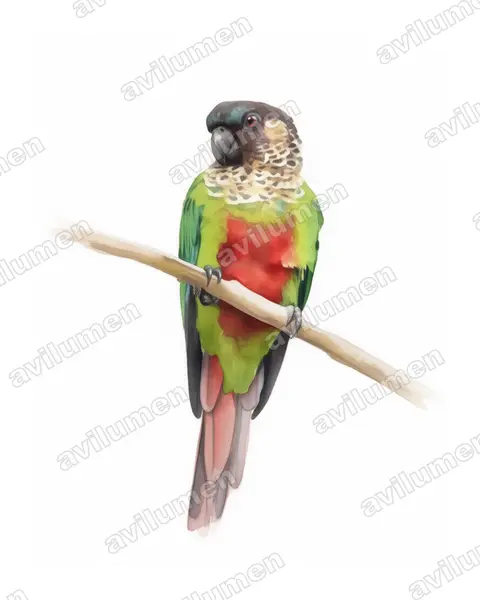
Watercolor 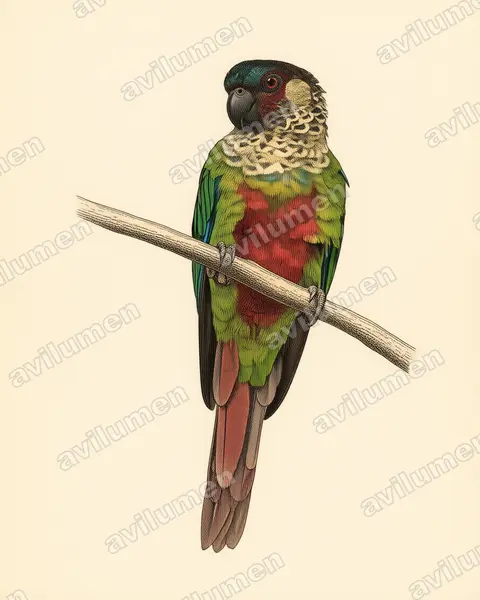
Vintage plate 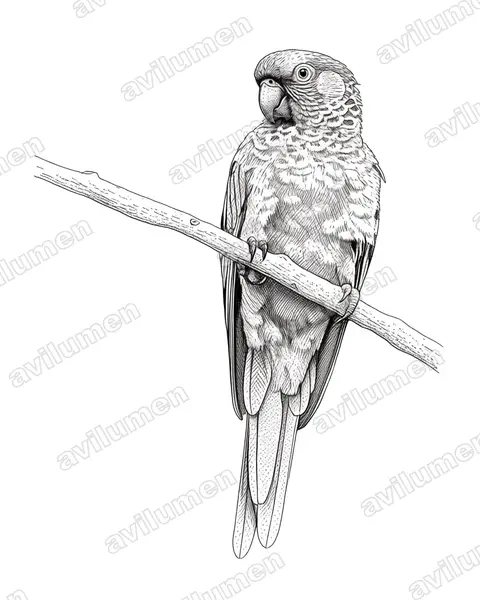
Ink 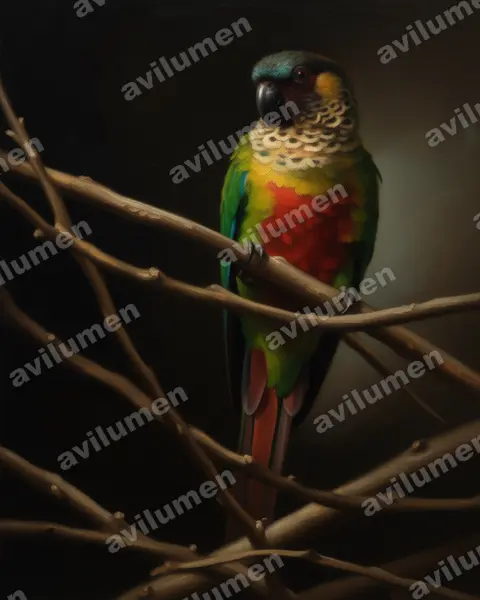
Oil 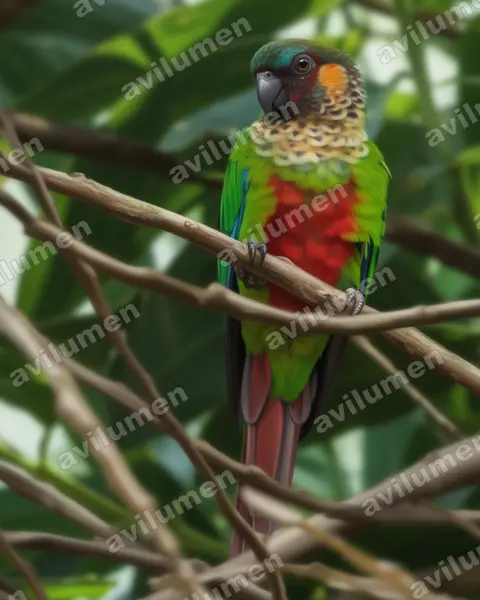
Realistic 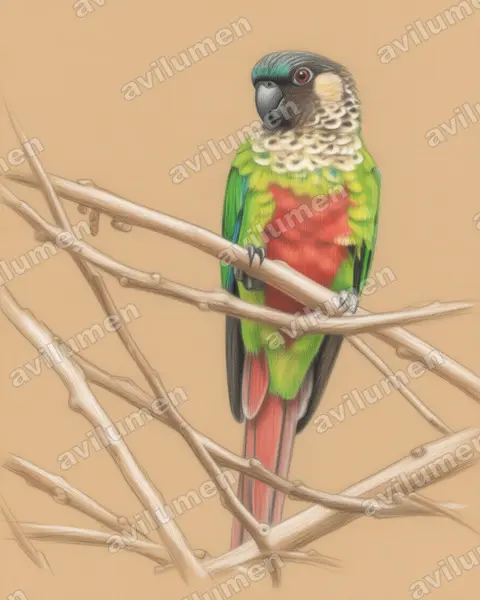
Colored pencil
Illustrations based on the photograph by Hector Bottai (CC BY-SA 4.0), from Wikimedia Commons.
Digital editions
HD Digital Art Pack — Hellmayr's Parakeet
Digital download: 6 high-resolution illustrations of the Hellmayr's Parakeet (Pyrrhura amazonum), print-ready. This is a digital file; no animal or physical item is included.
AI Avatar — Hellmayr's Parakeet
Generate an avatar fusing your face with the Hellmayr's Parakeet (Pyrrhura amazonum). Delivered digitally in 8K, watermark-free. Digital product; no animals are sold or brokered.
Instant download. No live birds are sold.
Frequently asked questions
- Is Pyrrhura amazonum (Hellmayr's Parakeet) endangered?
- The IUCN Red List places Pyrrhura amazonum, commonly known as the Hellmayr's Parakeet, in the «Near threatened» category. «Near threatened» means it is not threatened yet, but is close to becoming so.
- Where does Pyrrhura amazonum (Hellmayr's Parakeet) live?
- Pyrrhura amazonum (Hellmayr's Parakeet) is found in Brazil and South America.
- What family does Pyrrhura amazonum (Hellmayr's Parakeet) belong to?
- Pyrrhura amazonum (Hellmayr's Parakeet) belongs to the family Psittacidae, in the order Psittaciformes.
- What colour is Pyrrhura amazonum (Hellmayr's Parakeet)?
- The plumage of Pyrrhura amazonum (Hellmayr's Parakeet) combines these colours: Green and Yellow.
More from the same family
 Near threatened
Yellow-faced Parrot
Alipiopsitta xanthops
The yellow-faced parrot, formerly also known as the yellow-faced amazon, is the only species of the genus Alipiopsitta. It is a Neotropical parrot, and was classified in the genus Amazona for many years. It is a predominantly green and yellow-plumaged bird with a yellow head. It is a semi-nomadic species found in the cerrado region of Brazil and adjacent Bolivia.
from $1.99
 Least concern
Moluccan King Parrot
Alisterus amboinensis
The Moluccan king parrot is a parrot endemic to Peleng Island, Maluku, and West Papua in Indonesia. It is sometimes referred to as the Ambon king parrot or Amboina king parrot, but this is potentially misleading, as it is found on numerous other islands than Ambon. The male and female are similar in appearance, with a predominantly red head and underparts, green wings, and blue back and tail.
from $1.99
 Least concern
Papuan King Parrot
Alisterus chloropterus
The Papuan king parrot, also known as the green-winged king parrot, is a species of parrot in the family Psittaculidae found in New Guinea. Its natural habitats are subtropical or tropical moist lowland forest and subtropical or tropical moist montane forest.
from $1.99
 Least concern
Australian King Parrot
Alisterus scapularis
The Australian king parrot is a species of parrot endemic to eastern Australia ranging from Cooktown in Queensland to Port Campbell in Victoria. Found in humid and heavily forested upland regions of the eastern portion of the continent, including eucalyptus wooded areas in and directly adjacent to subtropical and temperate rainforest. They feed on fruits and seeds gathered from trees or on the ground.
from $1.99