Ochre-marked Parakeet
Pyrrhura cruentata
Avilumen editorial team ·

The ochre-marked parakeet is a species of parrot native to Brazil. It is also known as blue-throated parakeet in English and tiriba-grande, tiriba, cara-suja and fura-mato-grande in Portuguese. It is listed as Vulnerable (VU) on the IUCN Red List.
The ochre-marked parakeet (Pyrrhura cruentata) is a species of parrot native to Brazil. It is also known as blue-throated parakeet in English and tiriba-grande, tiriba, cara-suja and fura-mato-grande in Portuguese. It is listed as Vulnerable (VU) on the IUCN Red List.
Description
This colourful parakeet is a predominantly green bird with conspicuous red patches on its belly, rump, and shoulder and before, below and behind the eye. The crown is dark brown to blackish, becoming mottled on the nape of the neck, and there is a broad, bright blue bib on the chest, extending thinly around the back of the neck to form a faint collar. The outer primaries are blue, and the tail is olive-green above, and brownish red below.
Habitat
It inhabits the canopy of lowland humid forest and edge, occasionally up to 960 meters. It has also been recorded in small clearings and selectively logged forest, and persists (or at least persisted) in agricultural areas where many forest trees are retained (such as shade cocoa plantations). It feeds on seeds and fruit of secondary growth trees such as Trema micrantha and Cecropia. Feeding on agricultural crops has not been observed in the wild. Breeding apparently occurs in the austral spring, when 2–4 eggs are laid in a tree-cavity.
Distribution
Pyrrhura cruentata was formerly common throughout much of south-east Bahia, Espírito Santo, east Minas Gerais and Rio de Janeiro, Brazil. Its current distribution is highly fragmented and now mostly restricted to isolated reserves. The stronghold is the Sooretama Biological Reserve and adjacent Linhares Forest Reserve, Espírito Santo. It remains common in Estação Vera Cruz (formerly the Porto Seguro Reserve), Bahia. Elsewhere it can be relatively common, but numbers in the large Chapada da Diamantina and Monte Pascoal National Parks, Bahia, appear low.
Population
The population is estimated at 4.8 to 41 individuals per square kilometer times 1030 square kilometers for a total between 4944 and 42,230 individuals. It is best placed within the band 2500–9999 individuals.(Marsden et al. [2000]).
Threats
Extensive and continuing forest clearance is responsible for its current fragmented distribution. Its apparent tolerance of shade cacao plantations provides little hope because shading techniques since the 1980s have involved the use of banana and Erythryna trees, rather than standing forest, and unstable prices have resulted in conversion to pasture. Many remaining populations are now affected by site-specific threats such as conflicts between habitat conservation and the rights of local communities in Monte Pascoal National Park. Trapping for the cage-bird trade is a relatively new phenomenon, but the species is rare in national and international markets.
Conservation efforts
The bird is listed on CITES Appendix I and is protected by Brazilian law. It occurs in the Chapada Diamantina and Monte Pascoal National Parks, Barrolândia Experimental Station, Linhares Forest Reserve, Caratinga Biological Station, Rio Doce and probably Desengano State Parks, and the Córrego Grande, Córrego do Veado and Sooretama Biological Reserves.
Text adapted from Wikipedia · CC BY-SA 4.0
Where it lives
Distribution

Taxonomy
- Order
- Psittaciformes
- Family
- Psittacidae
- Genus
- Pyrrhura
- Conservation status
- Vulnerable
Listen to its call
No recording yet
Care guide
Budgie, Conure and Parakeet Care Guide
How to care for budgies, conures, parrotlets, ringnecks and other parakeets: diet, cage setup, health, behavior, breeding and legal status for owners.
Read the guide →Illustration gallery
6 illustrations of Pyrrhura cruentata (Ochre-marked Parakeet) in different styles, true to its real plumage. Shown watermarked; the art pack includes the high-resolution originals, ready to print.
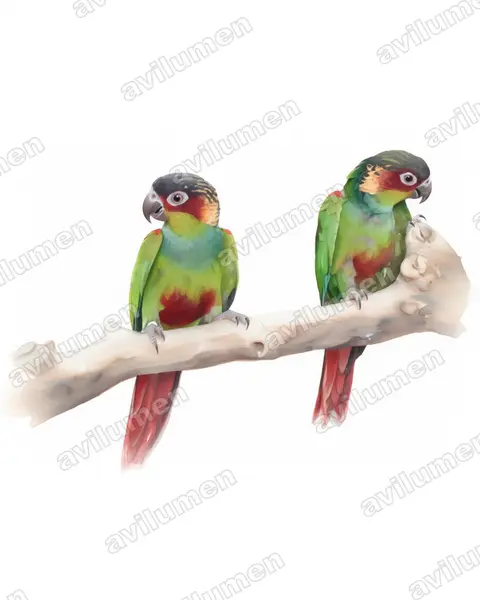
Watercolor 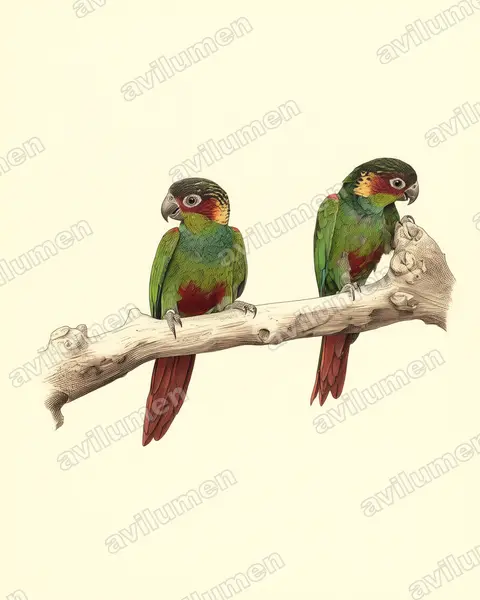
Vintage plate 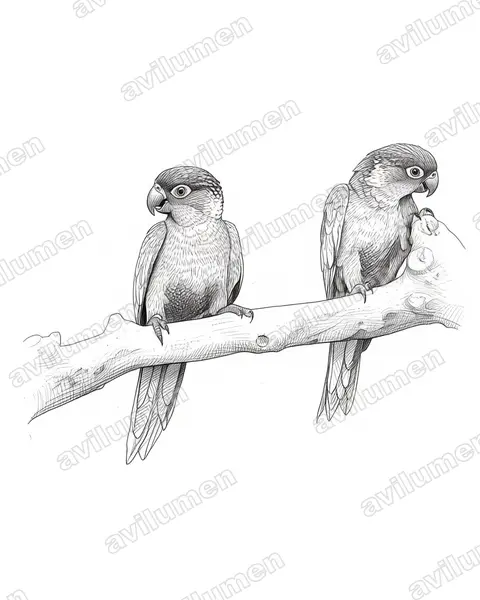
Ink 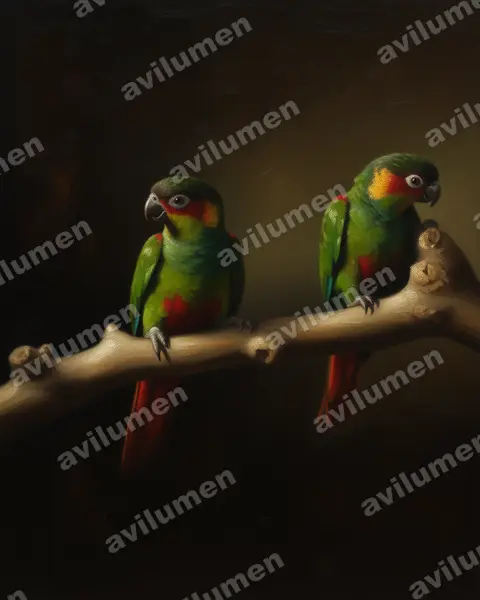
Oil 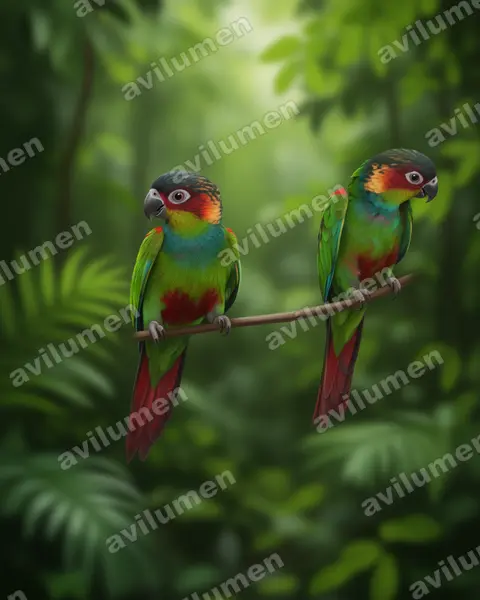
Realistic 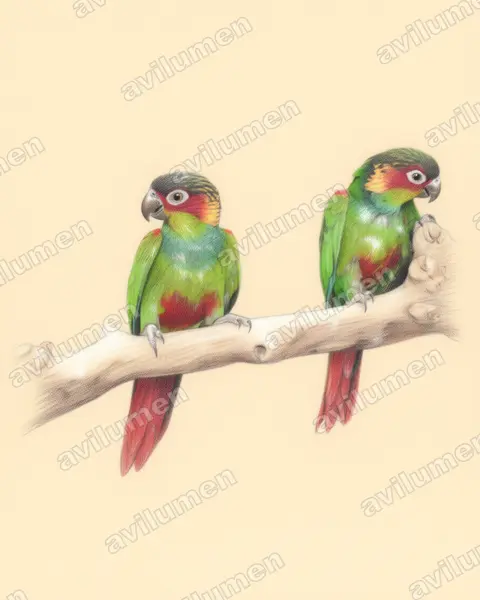
Colored pencil
Illustrations based on the photograph by TJ Lin (CC BY-SA 2.0), from Wikimedia Commons.
Digital editions
HD Digital Art Pack — Ochre-marked Parakeet
Digital download: 6 high-resolution illustrations of the Ochre-marked Parakeet (Pyrrhura cruentata), print-ready. This is a digital file; no animal or physical item is included.
AI Avatar — Ochre-marked Parakeet
Generate an avatar fusing your face with the Ochre-marked Parakeet (Pyrrhura cruentata). Delivered digitally in 8K, watermark-free. Digital product; no animals are sold or brokered.
Instant download. No live birds are sold.
Frequently asked questions
- Is Pyrrhura cruentata (Ochre-marked Parakeet) endangered?
- The IUCN Red List places Pyrrhura cruentata, commonly known as the Ochre-marked Parakeet, in the «Vulnerable» category. «Vulnerable» means it faces a high risk of extinction in the medium term.
- Where does Pyrrhura cruentata (Ochre-marked Parakeet) live?
- Pyrrhura cruentata (Ochre-marked Parakeet) is found in Brazil and South America.
- What family does Pyrrhura cruentata (Ochre-marked Parakeet) belong to?
- Pyrrhura cruentata (Ochre-marked Parakeet) belongs to the family Psittacidae, in the order Psittaciformes.
- What colour is Pyrrhura cruentata (Ochre-marked Parakeet)?
- The plumage of Pyrrhura cruentata (Ochre-marked Parakeet) combines these colours: Green and Red.
More from the same family
 Near threatened
Yellow-faced Parrot
Alipiopsitta xanthops
The yellow-faced parrot, formerly also known as the yellow-faced amazon, is the only species of the genus Alipiopsitta. It is a Neotropical parrot, and was classified in the genus Amazona for many years. It is a predominantly green and yellow-plumaged bird with a yellow head. It is a semi-nomadic species found in the cerrado region of Brazil and adjacent Bolivia.
from $1.99
 Least concern
Moluccan King Parrot
Alisterus amboinensis
The Moluccan king parrot is a parrot endemic to Peleng Island, Maluku, and West Papua in Indonesia. It is sometimes referred to as the Ambon king parrot or Amboina king parrot, but this is potentially misleading, as it is found on numerous other islands than Ambon. The male and female are similar in appearance, with a predominantly red head and underparts, green wings, and blue back and tail.
from $1.99
 Least concern
Papuan King Parrot
Alisterus chloropterus
The Papuan king parrot, also known as the green-winged king parrot, is a species of parrot in the family Psittaculidae found in New Guinea. Its natural habitats are subtropical or tropical moist lowland forest and subtropical or tropical moist montane forest.
from $1.99
 Least concern
Australian King Parrot
Alisterus scapularis
The Australian king parrot is a species of parrot endemic to eastern Australia ranging from Cooktown in Queensland to Port Campbell in Victoria. Found in humid and heavily forested upland regions of the eastern portion of the continent, including eucalyptus wooded areas in and directly adjacent to subtropical and temperate rainforest. They feed on fruits and seeds gathered from trees or on the ground.
from $1.99