Black-lored Parrot
Tanygnathus gramineus
Avilumen editorial team ·

The black-lored parrot also known as the Buru green parrot, is a parrot endemic to the Indonesian island of Buru. It is a 40 cm (16 in) long green parrot with black lores, and a turquoise crown. Males have red beaks, and females are gray-brown. The singing is high pitched and more protracted as compared to similar species, such as great-billed parrot.
The black-lored parrot (Tanygnathus gramineus) also known as the Buru green parrot, is a parrot endemic to the Indonesian island of Buru. It is a 40 cm (16 in) long green parrot with black lores, and a turquoise crown. Males have red beaks, and females are gray-brown. The singing is high pitched and more protracted as compared to similar species, such as great-billed parrot.
Taxonomy
The black-lored parrot was described in 1779 by the French polymath, the Comte de Buffon in his Histoire Naturelle des Oiseaux. He published a hand-coloured illustration in a separate publication. When in 1788 the German naturalist Johann Friedrich Gmelin revised and expanded Carl Linnaeus's Systema Naturae, he included the black-lored parrot with a short description, coined the binomial name Psittacus gramineus and cited Buffon's works. The black-lored parrot is now one of four species placed in the genus Tanygnathus that was introduced by the German naturalist Johann Wagler in 1832. The name Tanygnathus combines the Ancient Greek words tanuō "to stretch out" and gnathos "jaw". The specific epithet gramineus is from Latin and means "grasslike" or "green".
Distribution and habitat
The bird is rare and either fully or partly nocturnal, and therefore is poorly described. Its behaviour was reported by the Dutch ornithologist Hendrik Cornelis Siebers (in 1930. The bird predominantly occupies the central, more elevated part of the island of Buru, Indonesia, where it was reported at the settlements of Gunung Tagalago, Wa Temun and Kunturun at elevations of 700–1,100 meters (2,300–3,600 ft), as well on the southern lowlands at Fakal, Ehu and Leksula. There was one observation of these parrots near the Kayeli Bay at the eastern shores of Buru. More recent observations were made off the northern (Waflia) and northwestern (Wamlana) shores. The voice of the black-lored parrot was frequently heard at Kunturun, mostly 1–7 hours after the sunset, where the locals called the bird "kakatua ol'biru", meaning blue-headed parrot. However, it was caught during the day with slingshots in fruit trees suggesting that its activity is not purely nocturnal. Migration is relatively weak and there are only few reports of the parrots flying up and down hill at high altitudes overnight, as judged from their voices.
The population density of black-lored parrot is estimated as 1.3–19 birds/km2. These birds apparently favor high-altitude forests which on Buru have areas of 1,789 km2 above 900 m, and 872 km2 above 1,200 m. Those forests are relatively untouched by logging which affects coastal areas. Hunting or capturing of these birds by locals is rather limited, and there is only one report of the locals selling a captured black-lored parrot at a market of the nearby Ambon Island in 1998.
Nevertheless, owing to the small habitat, the species were listed as vulnerable since 1994 by the International Union for Conservation of Nature. The establishment of two protected areas on Buru, Gunung Kapalat Mada (1,380 km2) and Waeapo (50 km2), are partly aimed at preserving the habitat of the black-lored parrot.
Text adapted from Wikipedia · CC BY-SA 4.0
Taxonomy
- Order
- Psittaciformes
- Family
- Psittacidae
- Genus
- Tanygnathus
- Conservation status
- Vulnerable
Listen to its call
No recording yet
Care guide
Amazon, African Grey and Eclectus Parrot Care Guide
How to care for Amazon parrots, African greys, eclectus and pionus: diet, cage setup, health, behavior and CITES requirements for medium and large parrots.
Read the guide →Illustration gallery
6 illustrations of Tanygnathus gramineus (Black-lored Parrot) in different styles, true to its real plumage. Shown watermarked; the art pack includes the high-resolution originals, ready to print.
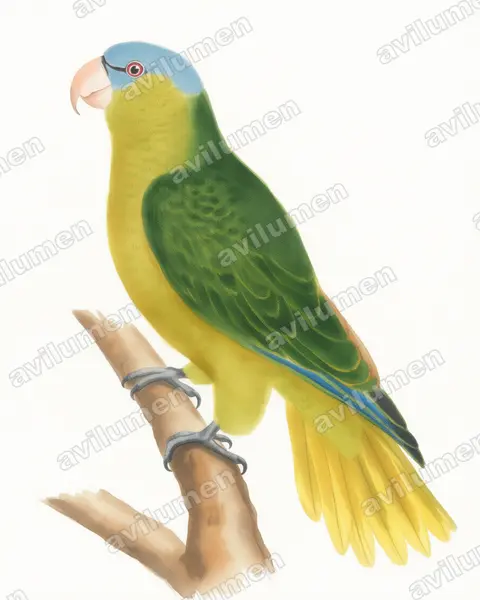
Watercolor 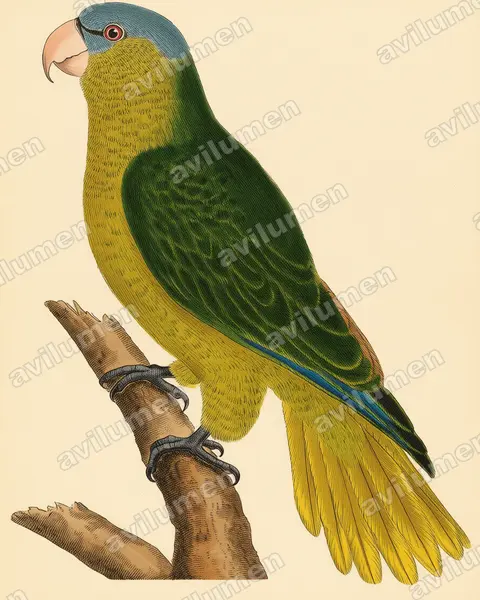
Vintage plate 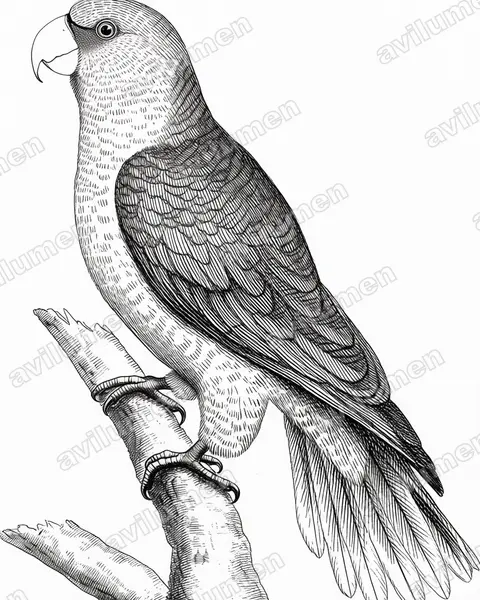
Ink 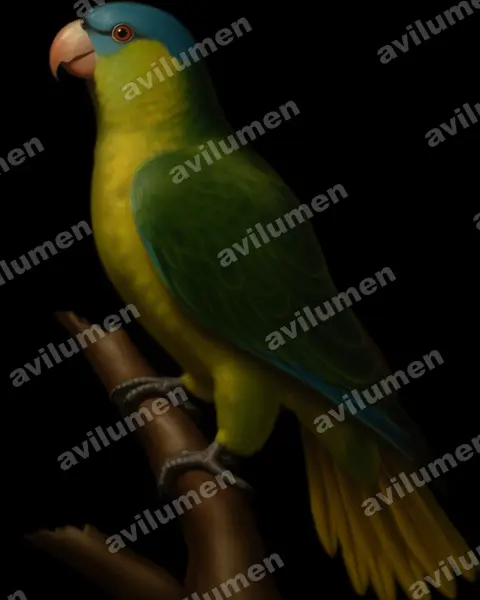
Oil 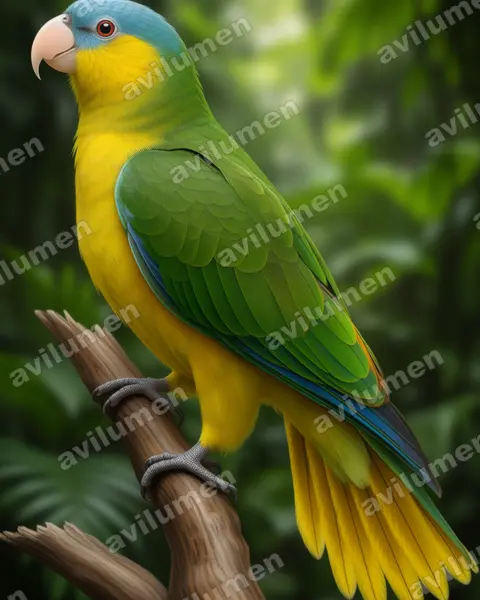
Realistic 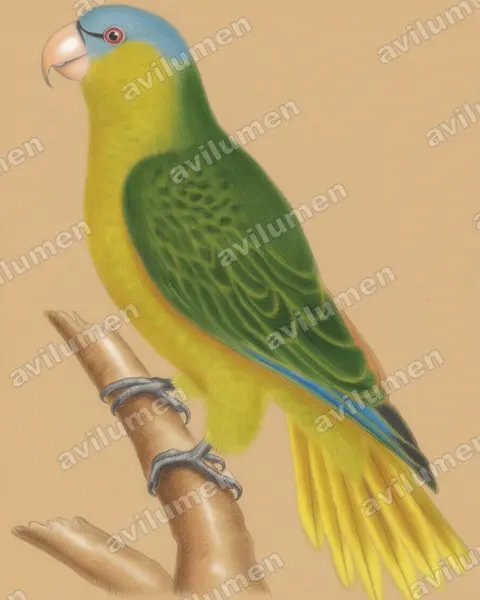
Colored pencil
Digital editions
HD Digital Art Pack — Black-lored Parrot
Digital download: 6 high-resolution illustrations of the Black-lored Parrot (Tanygnathus gramineus), print-ready. This is a digital file; no animal or physical item is included.
AI Avatar — Black-lored Parrot
Generate an avatar fusing your face with the Black-lored Parrot (Tanygnathus gramineus). Delivered digitally in 8K, watermark-free. Digital product; no animals are sold or brokered.
Instant download. No live birds are sold.
Frequently asked questions
- Is Tanygnathus gramineus (Black-lored Parrot) endangered?
- The IUCN Red List places Tanygnathus gramineus, commonly known as the Black-lored Parrot, in the «Vulnerable» category. «Vulnerable» means it faces a high risk of extinction in the medium term.
- Where does Tanygnathus gramineus (Black-lored Parrot) live?
- Tanygnathus gramineus (Black-lored Parrot) is found in Indonesia.
- What family does Tanygnathus gramineus (Black-lored Parrot) belong to?
- Tanygnathus gramineus (Black-lored Parrot) belongs to the family Psittacidae, in the order Psittaciformes.
- What colour is Tanygnathus gramineus (Black-lored Parrot)?
- The plumage of Tanygnathus gramineus (Black-lored Parrot) combines these colours: Green and Black.
More from the same family
 Near threatened
Yellow-faced Parrot
Alipiopsitta xanthops
The yellow-faced parrot, formerly also known as the yellow-faced amazon, is the only species of the genus Alipiopsitta. It is a Neotropical parrot, and was classified in the genus Amazona for many years. It is a predominantly green and yellow-plumaged bird with a yellow head. It is a semi-nomadic species found in the cerrado region of Brazil and adjacent Bolivia.
from $1.99
 Least concern
Moluccan King Parrot
Alisterus amboinensis
The Moluccan king parrot is a parrot endemic to Peleng Island, Maluku, and West Papua in Indonesia. It is sometimes referred to as the Ambon king parrot or Amboina king parrot, but this is potentially misleading, as it is found on numerous other islands than Ambon. The male and female are similar in appearance, with a predominantly red head and underparts, green wings, and blue back and tail.
from $1.99
 Least concern
Papuan King Parrot
Alisterus chloropterus
The Papuan king parrot, also known as the green-winged king parrot, is a species of parrot in the family Psittaculidae found in New Guinea. Its natural habitats are subtropical or tropical moist lowland forest and subtropical or tropical moist montane forest.
from $1.99
 Least concern
Australian King Parrot
Alisterus scapularis
The Australian king parrot is a species of parrot endemic to eastern Australia ranging from Cooktown in Queensland to Port Campbell in Victoria. Found in humid and heavily forested upland regions of the eastern portion of the continent, including eucalyptus wooded areas in and directly adjacent to subtropical and temperate rainforest. They feed on fruits and seeds gathered from trees or on the ground.
from $1.99